Atlas Testing
We pushed the Atlas 3115 brushless DC motor to failure to understand its thermal limits, validate propulsion simulations, and improve motor design.
Testing for Vector
Robust and accurate AI-native design relies heavily on data and theory that is readily available on the open market. Whilst this corpus of data supported designs accurate within 2-3% of reality for most of the power band of our motors, there was a clear issue that emerged repeatedly. Our models were divergent at the edges of motor performance. There are dozens of explanations for this - many of which are unrelated to the motor itself and a byproduct of a quirk in the ESC. To truly understand and eventually model the full span of a motor’s performance pre-prototype, we needed to create our own corpus of data. We invested heavily in our in-house test stand and its operation. We ran tests on motors across the industry and built Vector’s understanding of edge performance.
In the course of these tests, we have blown several motors. While some were more spectacular than others, they all colored our understanding of the limits of our motors and helped us expand them.
The Shoot
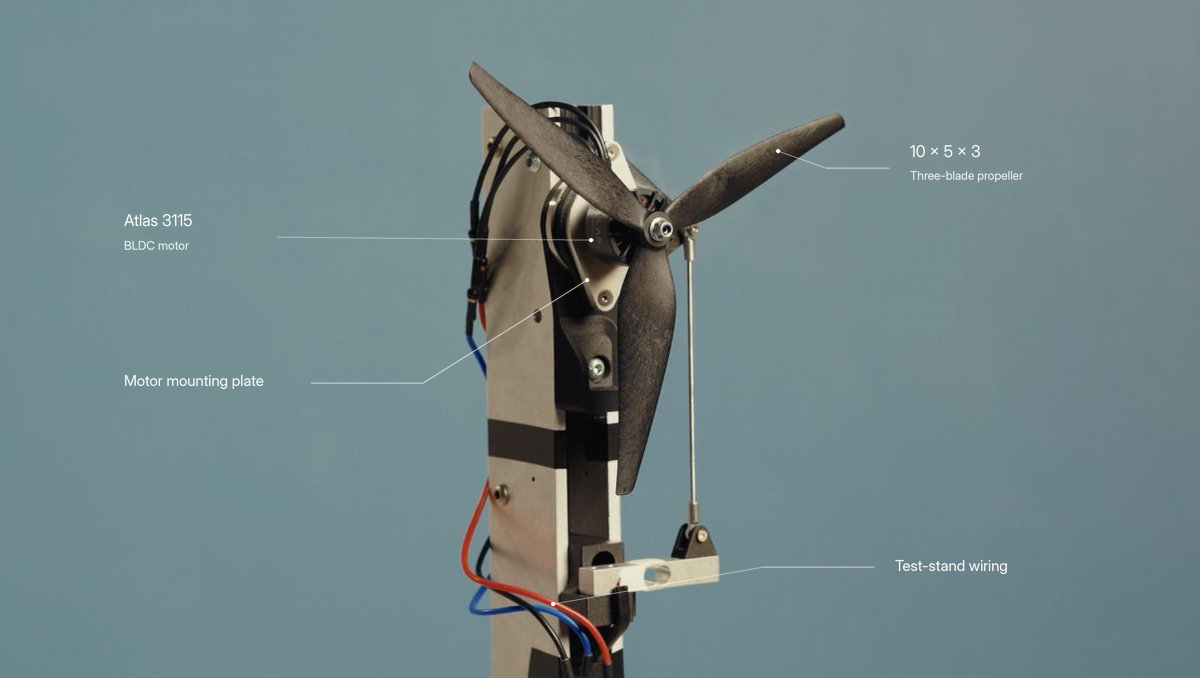
This was the first time on camera. We put a 3115 1100kV from our Standard Motor Series on the test stand, turned up the power, and filmed it all the way through.
It was fun to shoot. It also gave us data we needed: measurements near the motor’s current limit to check our simulations, understand the materials, and assess how well the design holds up. The test is deliberately destructive, and our goal was to understand what fails first, and how it behaved on the way there.
The battery, wiring, electronic speed controller (ESC), and propeller all affect the result. We’re measuring their combined behavior, with this ESC configuration and this propeller.
To simulate the motor, we need to simulate the battery and ESC as well. This test adds measurements at the current limit, where our data was thin.

With a 10×5×3 propeller fitted, we stepped the command from 25% to 100%. The 27.19-second run reached peaks of 105.4 A, 2.30 kW electrical input, 4.425 kgf thrust, and 13,329 valid RPM. These peaks occurred at different moments during the run and they do not represent a single operating point or continuous ratings.
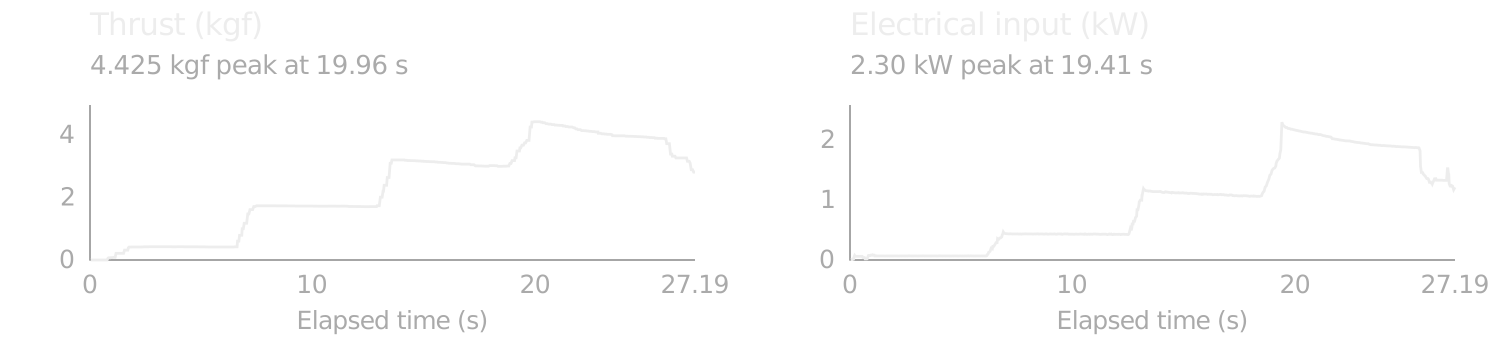
Even at full command, the motor didn’t maintain the same thrust throughout the run. Capturing that change helps us check how accurately our simulations reflect the real system.
Test Processing and Feedback
Alongside the footage, we recorded thermal video and temperature data to give us a record of the heat buildup during the run.
We ran the motor until the winding insulation melted. Each strand of winding wire has a thin insulating coating that keeps current on its intended path. Damage to that coating can allow current to pass between turns. Recording temperature during that process helps us check how well the coils of fine wire shed heat and assess the insulation against its specification.
After the burn, we reinstall the same rotor on a fresh stator to check for permanent loss of magnet strength. By replacing the damaged windings, we can investigate if the rotor’s magnets can withstand the conditions that caused the insulation to fail.
In doing so, we can assess the design’s demagnetization margin, rather than assuming that a rotor that still turns has retained its original performance.
The goal of our testing is to help us deeply understand our motion systems at a level that allows us to make better predictions and thus better design decisions.
Ultimately, engineers at Atlas build systems that create products. Instead of designing, fabricating, or testing individual motors or actuators, we create systems that design, manufacture, and test motors in vast numbers to feed our models that create more motors and actuators.
← All writing